Heavy duty versus standard plastic cutlery
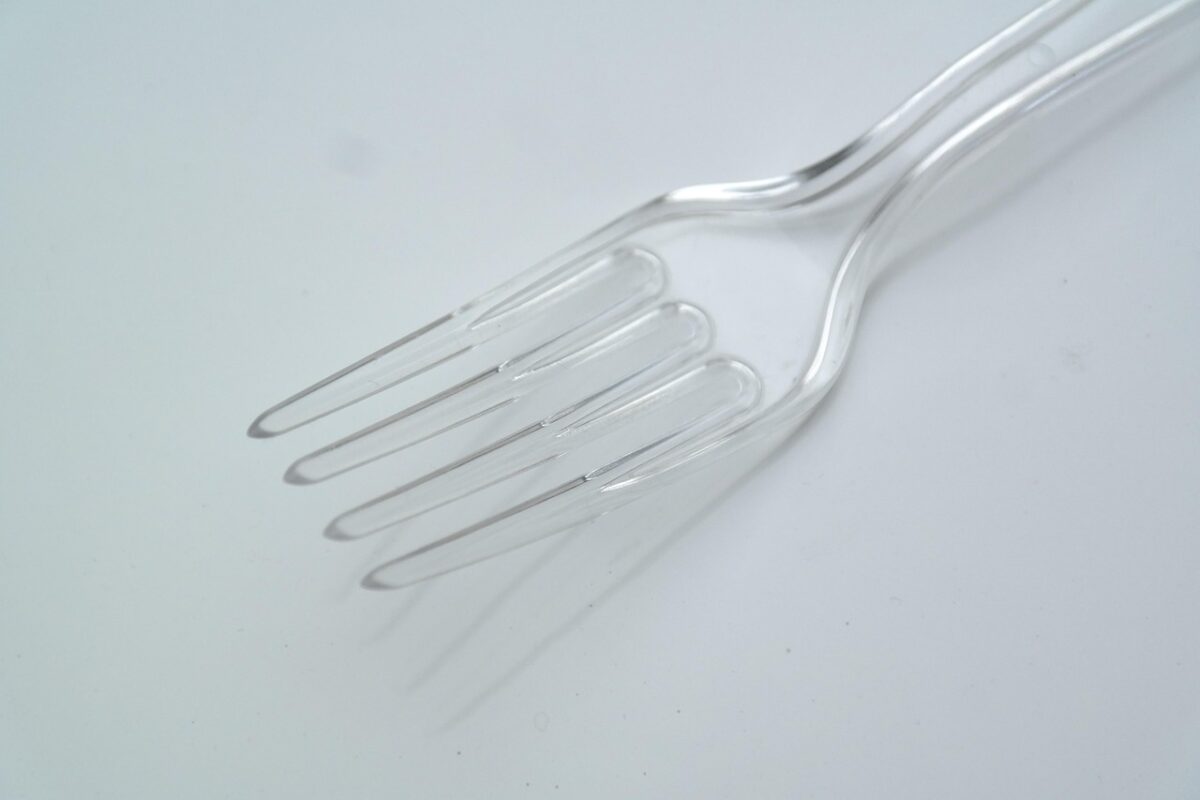
“Heavy duty” on a cutlery box is a description of wall thickness rather than a certification. More material means less flex, and less flex means the piece does not bend and then snap when it meets something firm.
Where standard weight is fine
Salads, pasta, rice, soft mains, cake, anything already cut into pieces. Most party menus, in other words. Standard-weight cutlery does this work perfectly and costs meaningfully less per piece.
For a hundred-guest event serving a soft buffet, standard weight is the correct call and the saving is real.
Where it is not
The failure cases are specific and predictable:
- Anything that needs cutting on the plate — chicken, steak, a chop.
- Firm roast vegetables, particularly potatoes with a crust.
- Hard-crusted bread and anything with a rind.
- Frozen or very cold desserts, where a spoon meets resistance.
In these cases a standard fork flexes, the tine bends past its limit and it snaps — usually mid-mouthful, and usually onto a plate somebody has to deal with.
The economics
The upgrade to heavy duty is a modest amount per piece. A snapped fork costs a replacement piece, a moment of awkwardness, and often a fresh plate. For a menu with anything firm on it, heavy duty is cheaper.
The mixed approach works well: heavy-duty knives and forks, standard-weight spoons. Spoons are almost never the piece that fails.
Heat resistance
Where a maker rates cutlery as heat resistant, they generally mean it holds its shape in contact with hot food rather than that it is oven-safe. A standard-weight plastic fork left in a hot dish deforms; a heavy-duty piece resists longer.
For soup and hot service, this matters as much as the strength does.
What “premium” usually means
Beyond thickness, premium ranges tend to differ in finish and shape: a longer handle, a more balanced weight, a polished rather than matte surface. These affect how the cutlery reads on a table more than how it performs.
For an event where the tableware is part of the presentation, that is worth something. For a children’s party, it is not.
Combo packs and the fork problem
Because forks fail most and are used most, a combo pack that splits evenly leaves you short in exactly the place that matters. Most makers weight combos towards forks for this reason; where a pack does not, a separate box of forks alongside is the fix.
Practical checks before ordering
- Look at the menu: anything that needs cutting means heavy duty.
- Consider heavy-duty forks and knives with standard spoons.
- Read any heat-resistance rating if hot food is served.
- Check the combo split and top up forks separately if needed.
- For presentation-led events, look at finish and handle length too.
Testing a sample before a large order
Weight descriptions are not standardised between makers, so one company’s standard can be another’s heavy duty. For a large or repeated order it is worth handling a piece first.
The quick test is to hold a fork by the handle and press the tines against a firm surface. A piece that flexes visibly under light pressure will snap on a roast potato; one that barely moves will not.
Presentation as well as strength
Heavier cutlery reads differently on a table. It sits flat rather than skittering, it does not rattle when the table is knocked, and it looks less obviously disposable in photographs.
For an event where the table is part of the occasion, that is a reasonable second argument for the upgrade beyond the practical one.
Storing the surplus
Because heavy-duty cutlery costs more, it is worth keeping the surplus properly: sealed, flat, and out of direct light. Plastic left in sunlight for months becomes brittle, which undoes the reason for buying it.
Where this sits in the shop
Everything discussed above comes back to one part of the shop: Disposable Cutlery, which currently holds 8 listings between $19.99 and $42.99. The whole of it is picked and packed at Paper House, 73 W 74th St, New York, NY, during Mon–Sat 9:30am–6:30pm, Sun 9:30am–5pm — so anything written here can be checked by phoning the counter on ((212) 724-8085.
From our shelves
- Phyyixs 360 Count Compostable Forks,Extra Heavy-Duty, Heat-Resistant & BPA-Free,Alternative — $25.99
- 550 Count Plastic Silverware Heavy Duty, 200 Forks, 200 Spoons, 150 Knives — $23.99
- SACATR 1000 Count Heavy Duty Plastic Knives Disposable — $42.99
What we get asked about this
What can I pay with?
Checkout accepts Pay with cards and more, Card, WeChat Pay, Airwallex – Express Checkout, Klarna and Afterpay. Card details are handled by the payment provider and never stored on this site.
Can I return something?
Yes — unused goods, within 30 days of delivery. If the mistake was ours, we pay the return postage. Full detail is on the Refund and Returns Policy page.
Read next
- Working out case quantities for a catered event
- Compostable, recyclable or plastic: choosing tableware
- Plate sizes and what each one is for
Ordering from Paper House
Orders of $49.00 or more ship free anywhere in the United States, and a flat $5.99 covers everything below that. Handling takes 1–2 business days and carrier transit is normally 3–7 business days. Unused items can go back within 30 days, and if the mistake was ours we pay the return postage.
Questions about anything above go to [email protected], answered within 1 business day, or call (212) 724-8085. Full detail is on the Shipping Policy and Refund and Returns pages.