Compostable, recyclable or plastic: choosing tableware
Three materials dominate disposable tableware and the labelling around them is genuinely confusing. Here is what each one is, and what determines whether the environmental claim is real in your building.
Conventional plastic
Usually polypropylene or polystyrene for cutlery, PET for clear cups. It is strong, cheap, heat resistant to a point, and dimensionally stable — a clear PET cup does not soften in a warm room.
It is recyclable in principle. Whether it is recycled in practice depends on the local stream and on whether the item is clean. Food-contaminated plastic frequently is not accepted.
Compostable material
Usually PLA (a corn-derived plastic), bagasse (sugarcane fibre) or moulded fibre. The important distinction is between home compostable and commercially compostable.
Most compostable tableware is commercially compostable, meaning it needs the sustained high temperatures of an industrial composting facility. In a garden compost heap it will sit largely unchanged; in landfill it behaves much like anything else.
So the useful question is not whether an item is compostable. It is whether the venue has a commercial composting collection. With one, compostables are a genuine improvement. Without one, the honest answer is that the benefit is small.
How it behaves at the table
PLA cutlery is slightly less flexible than plastic and softens with prolonged heat, so it is less suited to hot soup than to a cold buffet. Bagasse plates are sturdy, take hot food well and are not transparent. Moulded fibre absorbs oil over a long service.
Paper and wood
Paper plates vary enormously with coating and weight. An uncoated paper plate under anything wet is a short-lived object; a coated, heavier plate is fine. Wooden cutlery is sturdy and has a texture people either like or notice.
The claims and what they mean
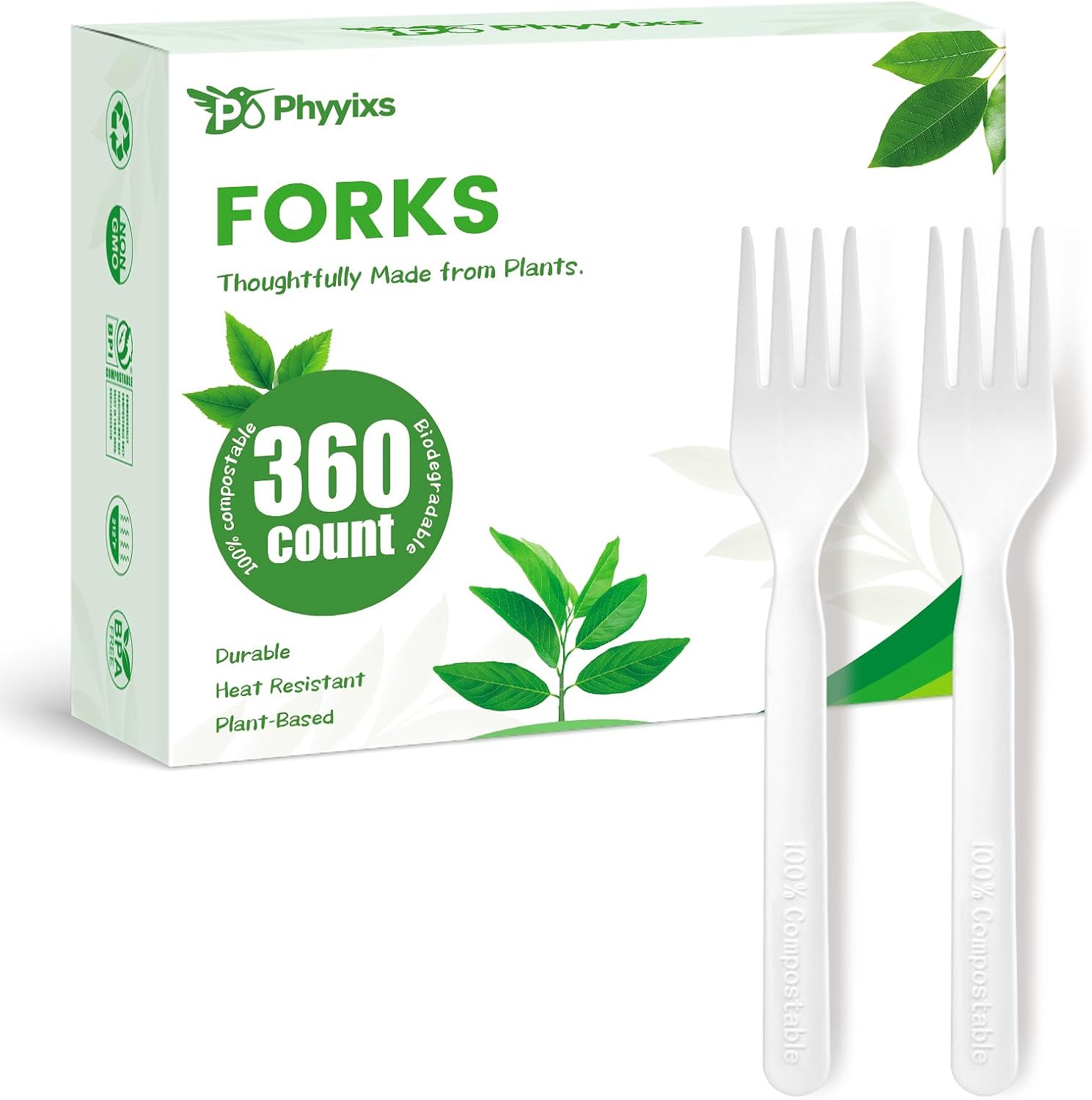
- BPA-free — contains no bisphenol A. Common on plastics and stated by the maker.
- Heat resistant — a maker’s rating, not a universal standard. Read the stated temperature where one is given.
- Compostable — usually commercially compostable. Check for a home-compostable claim specifically if that is what you need.
- Recyclable — the material can be recycled. Whether your collection accepts it is separate.
Where a maker states any of these, the listings here repeat their wording and do not add to it.
Choosing by menu, not by principle
Hot, oily food: coated bagasse or sturdy plastic. Cold buffet: anything on the list. Long service in a warm room: plastic holds its shape best. Children: light, unbreakable, and forget the rest.
A defensible approach
Find out what the venue’s waste collection actually accepts, then buy the material that stream handles. That single question does more than any label on a box, and it is the difference between a considered choice and a comforting one.
Practical checks before ordering
- Ask the venue what its waste streams accept before choosing material.
- Distinguish home compostable from commercially compostable.
- Match material to menu temperature and oil content.
- Read maker claims as written; treat anything unstated as unknown.
- Remember that using less of anything beats the material choice.
Separating waste on the night
Choosing a material only matters if the waste ends up in the right stream, and that is decided at the bin rather than at the point of purchase. Two or three clearly labelled bins, placed where people can see them, do more than any amount of careful buying.
Labels need to name the item rather than the material. “Cups and plates here” is understood instantly; “PLA and bagasse” is not, and a bin nobody understands becomes a general waste bin within an hour.
If the venue has one stream only, buying a single material throughout at least makes the outcome predictable, and it is worth knowing that rather than assuming a mixed order is being sorted somewhere downstream.
Emptying bins once mid-event matters too. A full bin is the point at which separation stops entirely and everything starts being left on tables.
Where this sits in the shop
Everything discussed above comes back to one part of the shop: Napkins and Table Signs, which currently holds 2 listings between $3.19 and $6.99. The whole of it is picked and packed at Paper House, 73 W 74th St, New York, NY, during Mon–Sat 9:30am–6:30pm, Sun 9:30am–5pm — so anything written here can be checked by phoning the counter on ((212) 724-8085.
From our shelves
- Bounty Paper Napkins, White, 200 Count, Packaging may vary — $3.19
- 12pcs Mini Chalkboard Signs with Stand,Food Labels for Party Buffet, Food Tag/Name Card for — $6.99
What we get asked about this
Do you ship outside the United States?
Not at present. We ship to US addresses only, including Alaska, Hawaii and territories the carrier serves.
Can I pick my order up at the shop?
Web orders are shipped, not held for collection. If you want to buy in person, come to 73 W 74th St, Apt 1A, New York, NY 10023, United States during opening hours (Monday–Saturday 09:30–18:30 · Sunday 09:30–17:00) and buy across the counter instead.
Read next
- Working out case quantities for a catered event
- Heavy duty versus standard plastic cutlery
- Plate sizes and what each one is for
Ordering from Paper House
Orders of $49.00 or more ship free anywhere in the United States, and a flat $5.99 covers everything below that. Handling takes 1–2 business days and carrier transit is normally 3–7 business days. Unused items can go back within 30 days, and if the mistake was ours we pay the return postage.
Questions about anything above go to [email protected], answered within 1 business day, or call (212) 724-8085. Full detail is on the Shipping Policy and Refund and Returns pages.